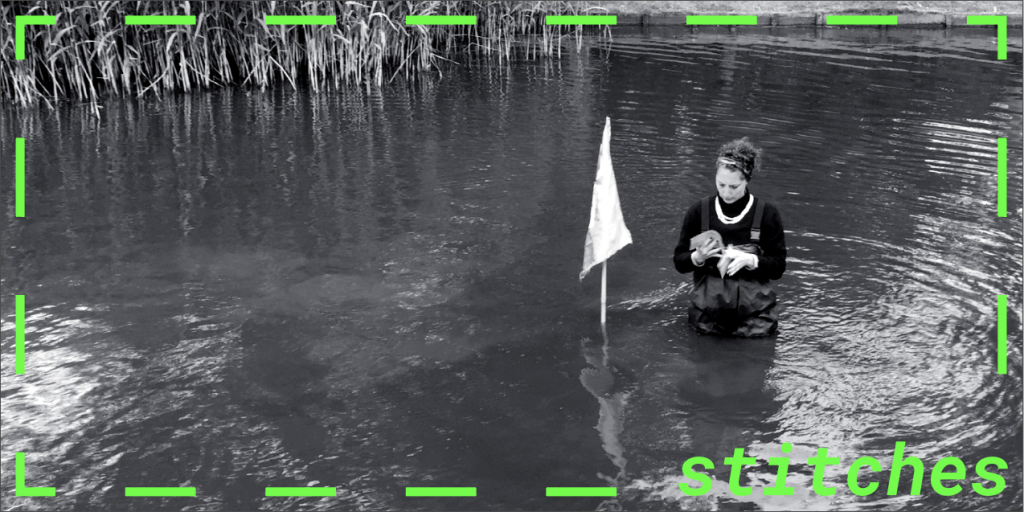
Giga: Hi, Moniek. It feels meaningful that at a certain moment, we were both connected to HDK-Valand. You were completing your PhD and your beautiful book, Leaving Dry Land: Water, Heritage and Imaginary Agency, right around the same moment I was finishing my Master’s there, also working with water bodies across different geographies.
Now that that chapter has closed, I’m curious: Where do you find yourself at the moment, and how are you imagining what comes next?
Moniek: Dear Giga, it is such a pleasure to start this conversation with you. I love how serendipity works—how, a little over two years after leaving Gothenburg, our paths cross here. And thank you for asking this question. Although it seems simple, I had to sit with it for a while. I remember you speaking to something similar in your micro-interview with Thomas Laurien.
In a very concrete sense, I’m back where I often return after longer tides abroad: Rotterdam. I live here with my partner, two children, a cat, two rabbits, a lively constellation of plants named by the kids, and a small fungal companionship we feed with our morning coffee grounds. Home, these days, feels like an everyday practice of radical care—and besides heaps of laundry, it brings me lots of music and play.
At the same time, I’ve been given the chance to attempt to create an academic home in Antwerp, which is both grounding and unruly. An institution is never just a building. It’s more like a weather system full of shifting pressures, unpredictable fronts, and sudden clearings. Still, I’m grateful for this opportunity because it brings me back to the questions that Leaving Dry Land set in motion: how water carries narratives across time and space, how it acts as witness and mnemonic ally, and how imagination can be more than escape—more like a form of attention, a matter of care.
What comes next is, again, shaped by water’s insistence on return. Soon I will travel back to Mexico City and the Yucatán Peninsula—places that have, by now, been part of my meanderings for over two decades. I’m currently working with the frictions around the infrastructure project of the Maya Train and the fragile underground freshwater worlds it cuts through: listening for multivocal stories that challenge official promises of progress, and tracing how resistance is expressed through art, cultural activism, and more-than-human presences.
So, I find myself somewhere between Rotterdam and elsewhere—between writing pages and wandering shorelines. And I’m still learning, still committed to practicing how to stay with the fluid, the porous, and the unresolved.
Giga: Thank you, Moniek. I love the image of the institution as a ‘weather system’—it resonates with the unpredictability we often face. And hearing about your ‘everyday practice of radical care’ with your family offers a beautiful grounding against the precarity we embody.
Your mention of the Maya Train and the frictions it creates feels like a mirror image of the anxiety we currently face here in Georgia. I am struck by how such projects are often shaped by a false mystery of antiquity or grand branding—such as the ‘Maya Train’ in Mexico or the ‘Silk Road’ project here. These names communicate a respect for history, yet the perverse physicality of these projects threatens to become a disaster for the natural heritage; the communities surrounding it—human or non—remain undervalued, hidden beneath the loud chants dedicated to progress.
Design is often complicit in these official promises of development. What do you think design looks and feels like when it shifts from its conventional, declared form to become a tool of resistance, operating in close proximity to local lifeworlds and communities?
Moniek: That mirror image of the Maya Train and the Silk Road stays with me. It is indeed intriguing and unsettling how “history” is used as a kind of soft alibi: a name that sounds like respect while, at the same time, the material project beneath it cuts through living worlds, treating them as collateral to so-called progress.
Your question made me think of my late friend Fernando Martín Juez—anthropologist, designer, and devoted admirer of the lifeworlds unfolding around his house in a small village near Mexico City. I remember his house, and spending time there, as a space for attention: books and objects, wide windows facing a ridge, a telescope aimed at the sky, a garden planted with care, sharing stories. He taught me something simple but demanding: that what we call “design” is entangled with shaping what we notice, what we cherish, what we consider worth protecting or conserving.
That is why I think (humbly) that a possible way to start answering your question about design becoming a tool of resistance is to refuse the posture that makes it so easily complicit: the urge to solve, fix, manage, salvage, as if the current polycrisis were a neat problem with a designable endpoint. Resistance, in that sense, begins by interrupting the rush toward answers long enough for stillness, grief, and trouble to be present.
This might look and feel like crafting conditions for another mode of attention: slowing down the tempo of certainty; making space where sensing can shift; staying close to local lifeworlds without turning them into data or context. In those conditions, water, land, memory, and other-than-humans stop being backdrops or metaphors and begin to act back, changing what can be asked, what counts as evidence, and what becomes imaginable.
But it is indeed a perverse battle and a double bind. Imagination is never innocent. The same imaginative force that can generate inclusive thoughts and beautiful forms can also become a lubricant for manipulation and control—exactly the kind of mythic branding you point to. That would mean that design-as-resistance is not a matter of good intentions or alternative aesthetics. It is rather an ongoing ethical practice of asking what a design helps circulate, whose reality becomes believable, whose suffering is quieted into the background, whose futures are made thinkable.
In that sense, I try to redirect imagination away from extraction and toward arts of noticing, situated listening, sensory encounters, and forms of bringing to the present what has been made absent or undervalued—without pretending this resolves the violence at stake. I am sure I do not get it right all the time. But I keep returning to the question of what my gestures enable: do they quietly feed the machine again, or do they open room for lifeworlds to matter, to refuse, and to thrive?
Giga: You describe Fernando Martín Juez as someone who enriches your understanding of what design fundamentally is — shaping what we notice, a lesson inseparable from the specific lifeworld he inhabited. In your thesis, your methodology moved iteratively between Mexico City and Gothenburg, each context deepening, reorienting, and even complicating the other. I’m curious whether working with water in a non-Western context like Mexico City produced insights that the European context simply could not have generated, or vice versa — not as an opposition, but as a kind of knowledge that carries its own weight and refuses to be absorbed into familiar frameworks. What does each context add that the other cannot generate on its own?
Moniek: I am writing this from Mexico City, which feels like the right place to sit with your question.
What working iteratively between Mexico City, Gothenburg, and Rotterdam did more than anything, over the past twenty years, was make me increasingly aware of my own epistemic positioning: how much I had absorbed, without noticing, the erasures and co-optations that come with the Eurocentric paradigm I grew up inside. That awareness is uncomfortable, even frightening—but it has become a difficulty I am learning to embrace. Moving between contexts unsettled what I thought I already understood, and slowly taught me that what I had imagined as opposites are, more often, inherently entangled.
Water helped me see this. It is a planetary entity, and yet every struggle over water is radically local. It also quietly dissolves categorical divisions. Although we might need categories to orient ourselves, perhaps we also need to rehearse other vocabularies of relationality that allow us to relearn what it means to be and to become, as humans, in a more-than-human world. Imagination, in that sense, is not a solitary or sovereign act. It is a relational practice, a rehearsal done with others, human and otherwise.
This brings me back to Fernando, who left his house, in his will, to a group of friends and neighbours, near and far, me among them. He named the cultural foundation he wished to house there “A World of Many Worlds,” after the motto of the EZLN, the Zapatista movement. Not the world as a singular, manageable project, but a world in which many worlds flourish, refusing the fantasy of universality without retreating into isolation. That cosmological generosity, an openness to awe and enchantment, is something I encounter more readily here in Mexico, and it has allowed me to keep questioning how Indigenous worldviews might pluralise and irrigate Eurocentric structures without being corrupted or co-opted in the process. I do not have a clean answer. But the question has become part of how I work.
And perhaps the biggest thing these iterative movements have given me—and this might sound strange in a time of polycrisis—is a growing wish to let go of urgency. Not indifference. Not inaction. But the recognition that you cannot truly imagine otherwise when you are locked in survival mode. Creating the conditions for other futures requires, at some point, the willingness to pause, to step outside the common rush, and to stay, for a moment, with what has not yet taken form.
So, if I were to try and gather what this iterative wandering has done: it has made me more entangled, more humble, and more porous, in a way I am still learning to inhabit. I came to water looking for what it carries across time and space, and it taught me, again and again, to look at myself: what I carry, what I circulate, and what I might, slowly and imperfectly, be willing to dissolve.
Giga: Moniek, I am grateful for the way this conversation has unfolded. It will stay with me as a meditation on vulnerability, or ‘porousness’, toward the veiled and complex ‘world of many worlds’ surrounding us. What strikes me most is the inherent risk of being in the world this way, both mentally and bodily; it stands in stark contrast to the comfortable certainty of a declared design that demands immediate solutions.
I will be following with great curiosity how your work in Mexico around the Maya Train and the world it cuts through continues to unfold.
Thank you for this beautifully insightful dialogue, Moniek. Now, I hand over the needle to you and hope you will continue to stitch.