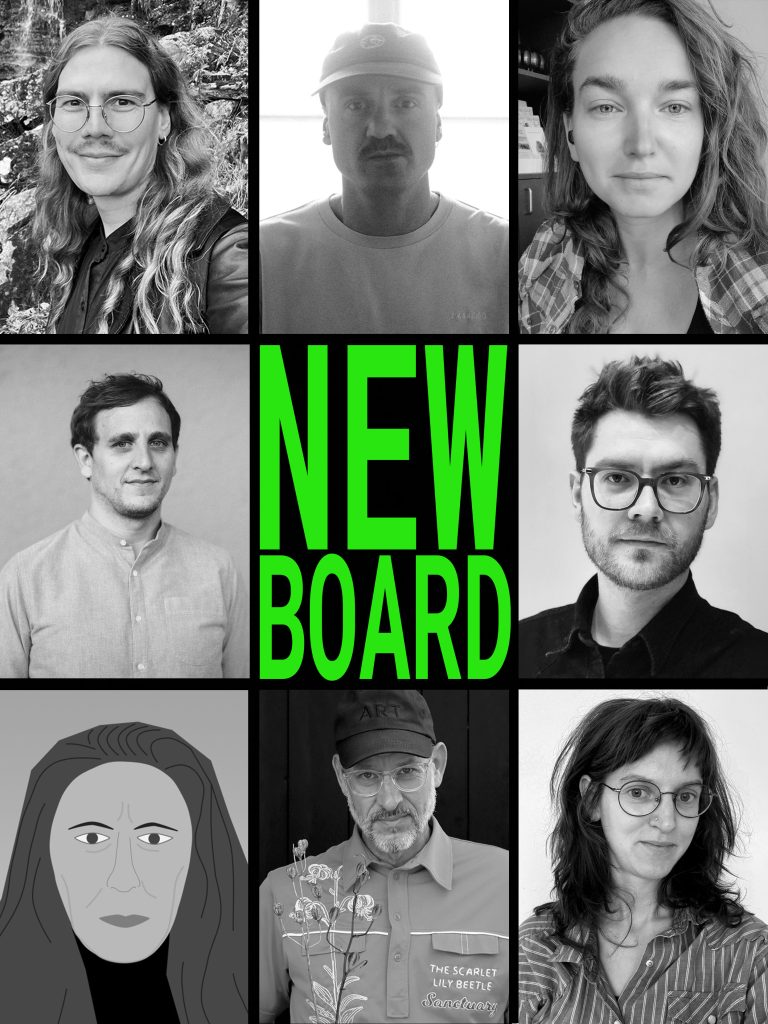
Our board comes together in a new constellation! After two years we welcome some new faces in the team. Since we are an informally structured network we regularly ask members to get involved on a more organizational level and so far we are happy to have been able to welcome everybody who signed up.
Here we are (top left to bottom right):
Anton Poikolainen Rosén (he/him) is an Assistant Professor at the Department of Computer and Systems Sciences at Stockholm University, Sweden, and studies design for regenerative futures in urban farming and waste management. He is co-editor of the book More-than-Human Design in Practice. Portfolio: www.poiros.com. In the network, he focuses on organising the Tools & Methods sessions (reach out if you want to present!) and on developing an online repository for sharing these tools and methods.
Christoph Matt (he/him) is an Austrian eco-social designer and interdisciplinary creative director currently based in Vienna. His work explores nature-human relationships through design, art, culture, and the natural sciences. Christoph founded Studio Matt | Eco-Social Design (www.studiomatt.design) to address ecological and social questions in society as well as the Nature Design Laboratory (naturedesignlaboratory.com) for artistic research and participatory design methods. He is also one of the co-founders of the European artist collective Sympoietic Society (sympoieticsociety.com), the international artist duo Dear Deer (archivesoftheearth.com) and independent artist-run gallery hafnar.space (www.hafnar.space). Within the Design + Posthumanism Network board Christoph is part of the website & communication working group.
Katka Katerina Cerna (she/her) is an educator, designer and an aspiring artist focusing on how to enable deeper connection to green nature. With a strong background in facilitating learning and collaboration, she uses design ethnographic and participatory approaches to understand how to enable actionable participation in the more-than-human world. More specifically, she focuses on ecological relationships around insects and plants as a way to develop deeper understanding of places. She is also a board member of Insect Worldings, an association working with multispecies design.
Sven Quadflieg (he/him) is a designer, design researcher, and professor of design at Hochschule Hamm-Lippstadt (HSHL), Germany. His research and design practice revolve around the social, political, and more-than-human dimensions of design – with a particular interest in decentering the human, in structures of privilege, and in the critical reflection of design methods, processes, and their potential failure. Within the network, his aim is to develop further collaborations on publications and joint funding applications.
Sebastian Gatz (he/him) is a trained car mechanic, licensed architect, and holds a PhD in Fine Arts in Design from Gothenburg University (HDK-Valand) in collaboration with Konstfack – University of Arts, Crafts and Design. He currently holds a postdoctoral position in artistic research at Konstfack and is stationed as a guest researcher at the Centre for Information Technology and Architecture (CITA), Royal Danish Academy, funded by the Swedish Research Council (Vetenskapsrådet). His current work explores Large Language Models (LLMs) as controllers and caretakers of robotic sensing and actuating devices in the context of architectural digital biofabrication, with a focus on cellulose-producing bacteria.
Jana Lumi (they/them) is an independent researcher and designer based in Tampere, Suomi, working in the messy, contested spaces where alternative communities, activist networks, and protest movements form and gather. Their research practice centers on finding approaches that are responsive and careful with groups who are often targeted or marginalized by dominant institutions — attending to what is already there rather than imposing frameworks from outside. Through salvaged urban materials and discarded matter, Jana also explores what art, design, and research can look like when literary and making practices refuse the boundaries that institutional culture draws around them. In the network they contribute to systems infrastructure across the network’s workgroups (website & communication, funding, onboarding, tools&methods).
Thomas Laurien (he/him) is a designer, curator, and senior lecturer/associate professor at HDK-Valand – Academy of Art and Design at the University of Gothenburg, Sweden. His research and artistic practice involve issues of care and more-than-human rights and representation, often in relation to water bodies and/or trees. Current projects are “Whose Body of Water?”, “Shimmer and Entanglements in the River Basin of Viskan”, “Design After Progress – Reimagining Design Histories and Futures”, and “Oak Trees and Humans – relations-shaping nature care.” Laurien is a founding member of the D+PH network and is one of the editors of the network’s website, as well as involved in the onboarding and tools&methods working group.
Johanna Mehl (she/her) is a graphic designer turned cultural studies scholar and design historian. She recently completed her PhD at the Chair of Digital Cultures, TU Dresden (Germany), where her dissertation examined the historical construction of design as problem-solving expertise in 1960s and 70s California. Her research sits at the intersection of design history and feminist and decolonial theory, tracing the cultural narratives that have shaped — and been shaped by — design practice. Within the network, she contributes to the website & communication and onboarding working groups, and leads the graphic design work.