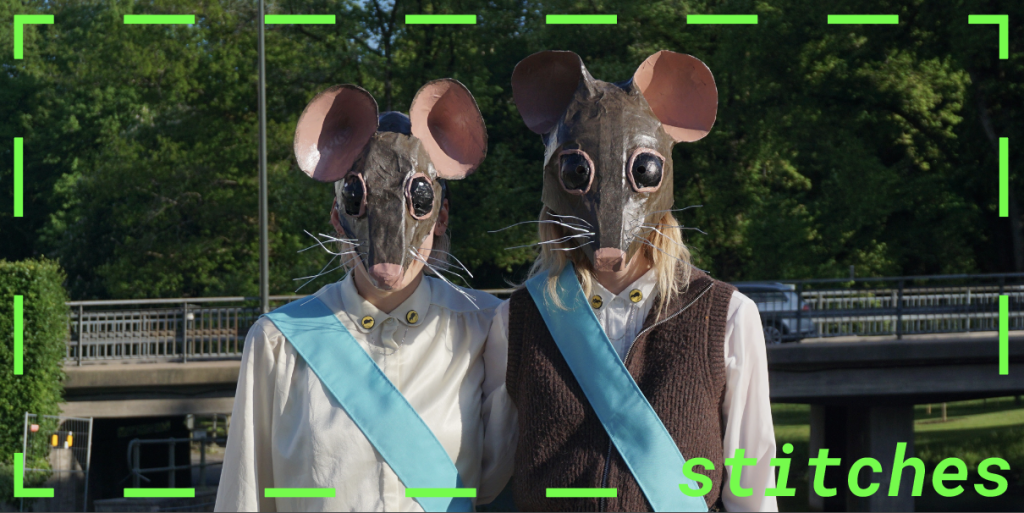
Burak: Hello Lisa and Del, it’s a pleasure to meet you. Thank you for taking the time to speak with me about Rat-ical Justice and your work with urban rats, “the most loathed, abhorred, revulsive creatures,” as you aptly describe. In your work, you approach urban rats not as a nuisance but as co-habitants in urban life. I’m curious about this shift in orientation. Was there a particular moment of encounter or realization, before or during your research, that led you to see rats as participants in the (un)making of designed environments?
Lisa Säfdal: Hi Burak – likewise! We really appreciate this opportunity to connect with you through our work.
It’s hard to pinpoint a single moment when that fell into place for us; perhaps we have always leaned toward a great curiosity and a willingness to recognize nonhumans for their agency and active participation within our built environments. What primarily motivated our work, and continues to do so, is the deeply intertwined and infected nature of our relationship with rats, whom the majority of us despise. Though we humans create the conditions for so-called “pests” to thrive, we fail, in many ways, to take accountability for their presence in our urban spaces. We subject them to our wrath and deny them our sympathy—which we find extremely unjust.
Early on in our thesis process, we could have decided to take a more pragmatic, solution-oriented approach by redesigning waste systems, rethinking urban infrastructure, or addressing the material conditions that sustain rat populations; however, we were much more interested in getting to the bottom of the psychological numbing we have collectively undergone in order to accept pest-control, which more often than not takes the form of execution, as the uncontested default response. The anthropocentric idea that the value of a nonhuman life is determined almost entirely by what it provides humans materially, emotionally, or in terms of survival—rendering urban rats nearly valueless, afforded little more consideration than waste itself—just never sat right with us.
So maybe it was not so much a shift toward seeing rats as co-habitants rather than nuisances, but rather a shift away from a human-centered, rational mode of problem-solving and toward a relational way of thinking that considers multiple forms of agency. We realized it is less a question of whether we like rats or not, and more a question of whether we really need to like them in order to act respectfully toward them. Drawing on one of our favorite quotes by Deborah Bird Rose and Thom van Dooren, we are curious about “how we may love that which causes us to suffer.” Our work does not try to make the case that rats don’t inflict suffering upon us but rather insists that their existence is valuable even if they do, while also exploring other, more caring, ways of relating to our entangled existence.
Burak: I’m very curious about this figure of the ambassador in your project. What does it mean, for you, to invite people into a position where they begin to speak for, with, or alongside rats, especially when empathy is not a given, due to what you describe as psychological numbing? How did you approach expanding this role beyond yourselves?
In my own work, I theorize this position as human proxy that emerges through interspecies relationships grounded in intentional care, and at times, by mere circumstance, for instance, designated by the veterinary system in cases of animal rescue. I wonder how you see this ambassadorial position operating in your project.
Delaney Davis: The ambassadorial position operates on two different levels in our work—we view it both as a formal political tool as well as a tool to disseminate information and ideas.
The former manifests as the situated position we inhabit as formal ambassadors in the Species Embassy of Viskan-Borås, where human representatives embody a particular nonhuman. By serving as diplomats, ambassadors bring a nonhuman presence into political arenas to demand accountability for issues that affect nonhumans. As rat ambassadors, we used this platform to advocate for spatial justice and to challenge extermination as the default governance.
This position is perhaps more closely aligned with your idea of the human proxy, but with a key distinction: in your example, the human proxy seems to emerge from rescue, care, or ownership, whereby our role of the ambassador emerges through inescapable and inevitable cohabitation and infrastructural entanglement—the motives are not inherently altruistic, and this relation between us and rats is not necessarily guardianship. In our work, we position rats as political subjects whose existence and rights must be acknowledged rather than as wards under our care. Because they cannot speak for themselves the role of the ambassador serves as this liaison.
Then we have the latter, the second level of ambassadorship, which we view as being the role of distribution and proliferation—how we expand the role beyond ourselves as formal ambassadors into less formal means of spreading information and awareness. This side involves experimenting with how ambassadorial responsibility might be shared with others through small, everyday gestures, such as placing rat-positive stickers around town or signing and adhering to an honorary code of conduct. As a role, it is voluntary rather than appointed and is therefore able to be taken on by a broader group. It carries ethical rather than legal responsibility and operates outside of institutional frameworks, and therefore also has the freedom to be performative and at times employ humor or emotional appeals rather than facts. This level of ambassadorship pertains predominately to social visibility, allowing for re-sensitization where psychological numbing has occurred.
Finally, we wanted to briefly touch on the fact that nonhuman ambassadorship is not without its ethical dilemmas—speaking on one’s behalf can often be a double-edged sword that we need to wield responsibly. We can use our more privileged human voices to communicate nonhuman experiences to other humans, but in the act of doing so, we inevitably project our own human experiences onto theirs. How accurately can we be a mouthpiece for a species whose lives we have never and will never experience ourselves? In our work, we try to be led by the idea of “doing the most possible good”—understanding the fact that we will never perfectly be able to convey their experiences, but still using our platform to advocate on their behalf.
Burak: Your idea of “doing the most possible good” really resonates with care theory, where we see a reorientation away from universal, binary notions of right and wrong toward understanding and responding to situations in their particular contexts.
You acknowledge that speaking for another species inevitably involves projection. Since you also work with anthropomorphism in strategic and performative ways, I’m curious how you think about its limits in practice. During your public engagements as formal ambassadors in the Species Embassy of Viskan-Borås, were there specific moments when anthropomorphism opened up new relational possibilities or moments where it risked oversimplifying or re-centering the human? Could you perhaps share an example?
Lisa: Ah, yes—this question touches on a central tension that accompanied us all throughout the project, and very much still does. We’ve repeatedly found ourselves having to pause and recalibrate, asking whether our strategies, especially when working with strategic anthropomorphism, risk reinforcing the very anthropocentric logic we are attempting to unsettle.
Through our encounters with audiences—whether in our formal ambassadorship, in public presentations or informal conversations—we noticed that appealing to our emotional soft spots by telling stories about how rats laugh when being tickled, or that they can learn how to drive a tiny car, proved remarkably effective in altering the tone of a conversation. Whenever we shared these anthropomorphic anecdotes, something shifted: people leaned in, smiled, softened. Disgust momentarily gave way to curiosity. In that sense, anthropomorphism clearly functioned as a relational bridge. It created a crack in the dominant narrative. But at the same time, we became uneasy with how quickly this could shift the argument toward proving rats’ worth in human terms. The conversation risked becoming: Look, they are like us. They deserve empathy because they resemble us.
What complicated this further is that, while a post-anthropocentric perspective feels almost intuitive to us, we often encountered audiences for whom it did not register at all. For some, the claim that rats have value independent of human perception appeared naïve or absurd. In those situations, beginning “outside” the anthropocentric system simply closed the conversation. We realized that if we want to be understood at all, we sometimes have to begin from within the very logic we are trying to stretch.
We realized that there seems to be a paradox that arises when working simultaneously from inside and outside an anthropocentric system. On the one hand, our work is firmly situated within a post-anthropocentric theoretical framework in which the value of nonhuman life should not depend on whether we find it appealing, intelligent, or emotionally resonant. But on the other, we operate within a deeply anthropocentric cultural system where recognition often begins through emotional access points. From within that system, anthropomorphic gestures can function as a strategic translation device—not because they are philosophically pure, but because they can temporarily interrupt the psychological barrier caused by disgust, fear, or habitual dismissal. Without that initial foothold, the deeper critique risks never being heard.
What became clear to us is that anthropomorphism opens relational possibilities when it destabilizes fixed narratives—when it complicates the image of the rat and reveals how partial our assumptions are. But it risks oversimplifying when it collapses difference, when the rat becomes merely a mirror of the human, or when empathy becomes conditional upon similarity.
Perhaps the paradox is not something to eliminate but something for which we must remain accountable. Working between the real and the ideal means accepting that, at times, we must operate within the very language we seek to transform. The key for us has been to stay attentive to when anthropomorphism functions as an opening versus when it quietly recenters the human as the measure of all value.
Burak: I really appreciate how you describe anthropomorphism as something that must be navigated from within the situations we inhabit rather than resolved once and for all. The idea of treating it as a tension to remain accountable to, rather than something to eliminate, resonates strongly with my own work as well.
It has been a real pleasure learning more about Rat-ical Justice and your ambassadorial approach to engaging publics. I also see many interesting overlaps with my own work on more-than-human design and everyday forms of ambassadorship, so I hope our paths might cross again in the future. Thank you both for taking the time to share your thoughts and experiences with such openness. Now, I hand the needle back to you and hope you will continue the thread.